
If you have ever dug a fence post, planted a tree, built an arena, or simply walked through Hitchcock Woods, you already know one thing about Aiken, South Carolina: we have a LOT of sand.But have

Dated: September 27 2026
Views: 0
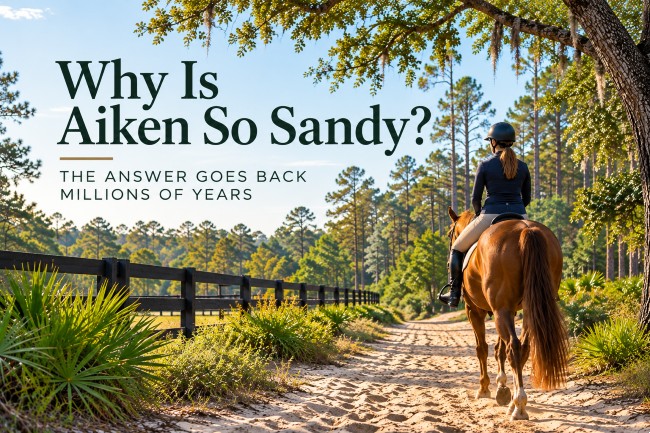
If you have ever dug a fence post, planted a tree, built an arena, or simply walked through Hitchcock Woods, you already know one thing about Aiken, South Carolina: we have a LOT of sand.
But have you ever wondered why?
The answer is one of my favorite pieces of Aiken trivia: this part of South Carolina was once along the edge of an ancient Atlantic coastline.
That sounds a little unbelievable when today's beach is more than two hours away, but the geology underneath Aiken tells the story.
Aiken sits in South Carolina's Sandhills region, a band that runs roughly from Aiken through Columbia and northeast across the state.
Millions of years ago, sea levels were considerably higher and the Atlantic Ocean extended much farther inland than it does today. Sand and clay accumulated along this ancient coastal area, while waves and tides helped shape beaches, sand ridges, and dunes.
Much of the sandy landscape we see around Aiken today is the result of those ancient coastal deposits.
The Fall Line marks the transition between the harder rocks of South Carolina's Piedmont and the softer sediments of the Coastal Plain.
Aiken sits just southeast of that transition and is part of the Sandhills region. Beneath us are layers of sand and clay deposited over an extremely long period of geologic history.
That ancient geography helps explain why our landscape looks so different from the red-clay Piedmont found farther north and west.
Those ancient coastal deposits help explain Aiken's familiar rolling terrain and sandy soils.
For gardeners and farmers, sandy soil can sometimes be challenging because it drains quickly and doesn't hold water particularly well.
For horses, however, that sand has helped shape an entirely different story.
Aiken's sandy ground is one of the characteristics that makes this area so appealing for horses.
After rain, our sandy soils generally drain much faster than heavy clay. Anyone who owns horses knows how valuable that can be during a wet winter: less standing water, less deep mud, and more opportunities to keep riding.
Combine that footing with Aiken's relatively mild winters, and it isn't difficult to understand why horses became such an important part of the community.
By the late 1800s, wealthy Northerners were spending winters in Aiken and bringing their horses with them. Riding, racing, foxhunting, and polo became major parts of the Aiken Winter Colony lifestyle.
Over time, that sporting tradition grew into the diverse equestrian community we have today.
Once you know what you're looking at, Aiken's ancient geology becomes much easier to recognize.
You see it in our rolling terrain, pine forests, sandy roads, and riding trails. You see it when an arena drains surprisingly quickly after a heavy rain.
And you definitely see it when your horse brings half of Aiken's sand back into the barn after a ride.
It's also part of what makes places such as Hitchcock Woods so distinctive. The 2,100-acre forest sits right in the heart of Aiken and its miles of sandy trails have been used by generations of riders.
The sandy landscape wasn't created for Aiken's equestrian community.
The equestrian community developed, in part, because the landscape was already here.
When people research moving to Aiken SC, they understandably focus on property prices, equestrian communities, riding trails, horse shows, and the cost of keeping horses here.
But geography is another interesting piece of the puzzle.
The same ancient landscape that shaped the South Carolina Sandhills also helped make Aiken a practical place to train and keep horses. Millions of years of geology eventually contributed to a community known today for polo, eventing, dressage, foxhunting, Thoroughbred training, and recreational riding.
So the next time you're riding down one of Aiken's sandy trails, remember:
You're riding across a landscape shaped by an ocean that disappeared millions of years ago.
Curious about living—and riding—in Aiken? I'm always happy to help you explore the area and its equestrian communities.
Miriam Graybeal | 561-603-5580 | miriamgraybeal@gmail.com
#AikenSC #AikenHistory #AikenEquestrian #AikenHorseCountry #MovingToAikenSC #AikenRealEstate #SouthCarolinaSandhills

Real Estate Agent | Specializing in residential and equestrian properties in Aiken, SC With the unique combination of experience in real estate, as an equestrian, and with a background in digital....
If you have ever dug a fence post, planted a tree, built an arena, or simply walked through Hitchcock Woods, you already know one thing about Aiken, South Carolina: we have a LOT of sand.But have
Fall has officially arrived in Aiken, South Carolina — even if our afternoon temperatures occasionally need a little convincing.For many of us, this is one of the best times of year in Aiken.
Events in Aiken This Summer: What's Happening in June and July 2026If you think Aiken's equestrian calendar goes quiet in the summer, think again. While the big spring season has wrapped up, June
June 2026 Equestrian Events in Aiken, SCSummer may be heating up, but the equestrian calendar in Aiken remains active with hunter/jumper competition, dressage shows, eventing, and educational
 Aiken Board of Realtors® All information deemed reliable but not guaranteed. All properties are subject to prior sale, change or withdrawal. Neither listing broker(s) or information provider(s) shall be responsible for any typographical errors, misinformation, misprints and shall be held totally harmless. Listing(s) information is provided for consumer's personal, non-commercial use and may not be used for any purpose other than to identify prospective properties consumers may be interested in
purchasing. The data relating to real estate for sale on this website comes in part from the Internet Data Exchange program of the Multiple Listing Service. Real estate listings held by brokerage firms other than eXp Realty, LLC - Aiken(SC) may be marked with the Internet Data Exchange logo and detailed information about those properties will include the name of the listing broker(s) when required by the MLS. Copyright ©2026 All rights reserved.
Last Updated: September 28, 2026 1:53 AM UTC
Show More...
Aiken Board of Realtors® All information deemed reliable but not guaranteed. All properties are subject to prior sale, change or withdrawal. Neither listing broker(s) or information provider(s) shall be responsible for any typographical errors, misinformation, misprints and shall be held totally harmless. Listing(s) information is provided for consumer's personal, non-commercial use and may not be used for any purpose other than to identify prospective properties consumers may be interested in
purchasing. The data relating to real estate for sale on this website comes in part from the Internet Data Exchange program of the Multiple Listing Service. Real estate listings held by brokerage firms other than eXp Realty, LLC - Aiken(SC) may be marked with the Internet Data Exchange logo and detailed information about those properties will include the name of the listing broker(s) when required by the MLS. Copyright ©2026 All rights reserved.
Last Updated: September 28, 2026 1:53 AM UTC
Show More...
